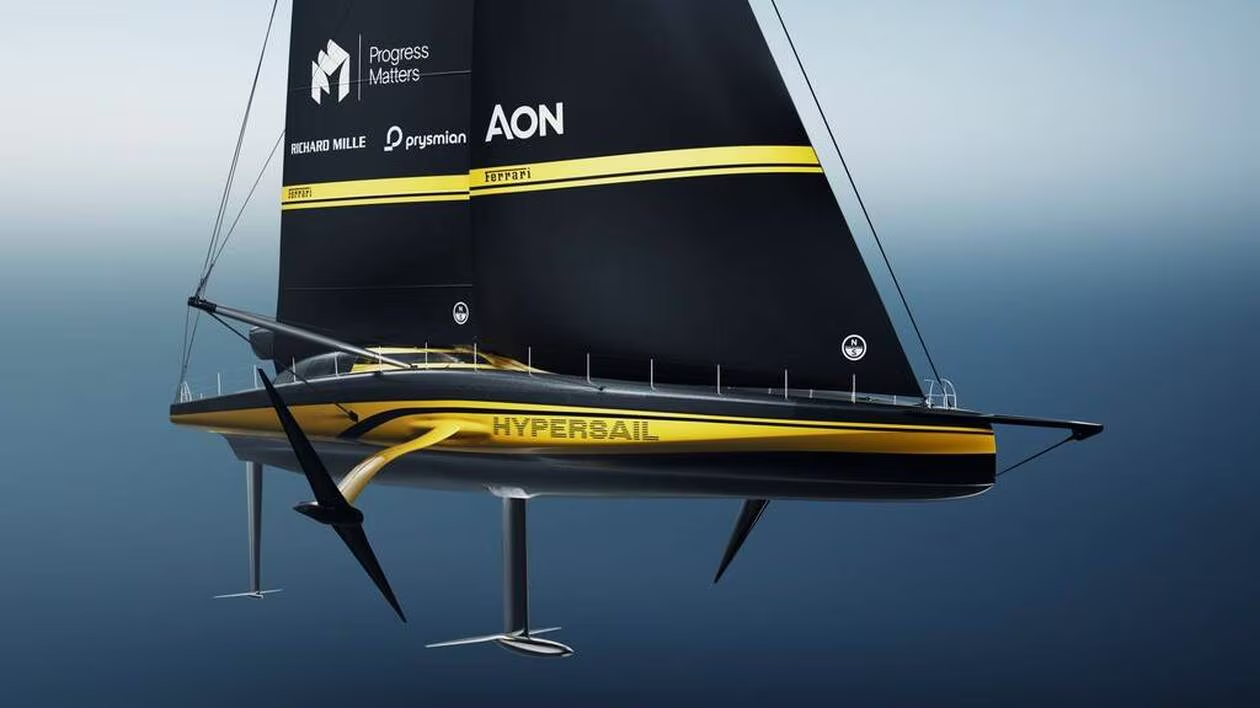
Ferrari enters the world of sailing with the Hypersail, a 100-foot flying monohull designed by Guillaume Verdier. The Italian manufacturer, known worldwide for its racing and luxury cars, now wants to apply to offshore racing the principles that have shaped its automotive legend.
A laboratory without class rules
With its new boat, Ferrari has chosen not to be constrained by a set of class rules, allowing it to experiment with and test every possible solution in the pursuit of maximum speed. The monohull is therefore designed to sail on several lifting surfaces. A lateral foil, another fitted to the rudder, and a third associated with the canting keel should help unload the hull and potentially keep it largely above the water. The objective is clear: maximum speed. The less the hull touches the water, the lower the resistance and the higher the speed. But the equation becomes considerably more complex when this balance has to be maintained in heavy seas for several days or even weeks… And this is precisely where Ferrari’s team believes it can make the difference.
From F1 to the ocean
Beyond the speed the Hypersail might achieve, the project is above all intended to serve as a genuine electronics laboratory. The movement of the foils will be controlled by systems capable of continuously analysing the boat’s attitude and correcting its behaviour. Ferrari intends to draw on its expertise in onboard electronics, aerodynamics and energy management – technologies that its Formula 1 team uses every day. The boat will notably feature a high-voltage electrical architecture directly inspired by technologies developed for the brand’s highest-performance cars.
The manoeuvres themselves have also been rethought. The energy generated by the crew on pedal systems can be converted into electricity before being used to power certain onboard systems. This provides a more precise way of managing the available power, at a time when the forces that need to be transmitted can reach several tonnes.
This approach gives a clear idea of the project’s philosophy: on the Hypersail, performance will not depend solely on the shape of the hull or the sail area, but on the ability of the entire boat to operate as a single, integrated system.
Energy autonomy at the heart of the project
Ferrari also wants to minimise its reliance on an internal-combustion engine to generate electricity. Around 100 m² of solar panels are to be integrated into the boat, while other systems may supplement this energy production. This energy will have to power the instruments, sensors, hydraulic systems and, above all, the flight-control system. This represents a considerable challenge on a boat whose electrical consumption will, naturally, be significantly higher than that of an offshore racing yacht such as those seen in the Vendée Globe or the Route du Rhum. The team assembled around Enrico Voltolini, an engineer and sailor who has notably worked with Luna Rossa, includes specialists from offshore racing, the America’s Cup and foiling. A logical choice for a boat positioned precisely at the crossroads of these three worlds. The launch, initially planned for 2026, is now scheduled for the first quarter of 2027, with Livorno serving as the boat’s base for its initial testing campaigns.
The round-the-world race in sight
After its first outings and an inevitably complex development phase, Ferrari is setting its sights on a crewed circumnavigation of the globe, with the ultimate ambition of winning the Jules Verne Trophy – a feat no monohull has ever achieved. A challenge that would undoubtedly have appealed to the legendary Enzo… Ferrari!