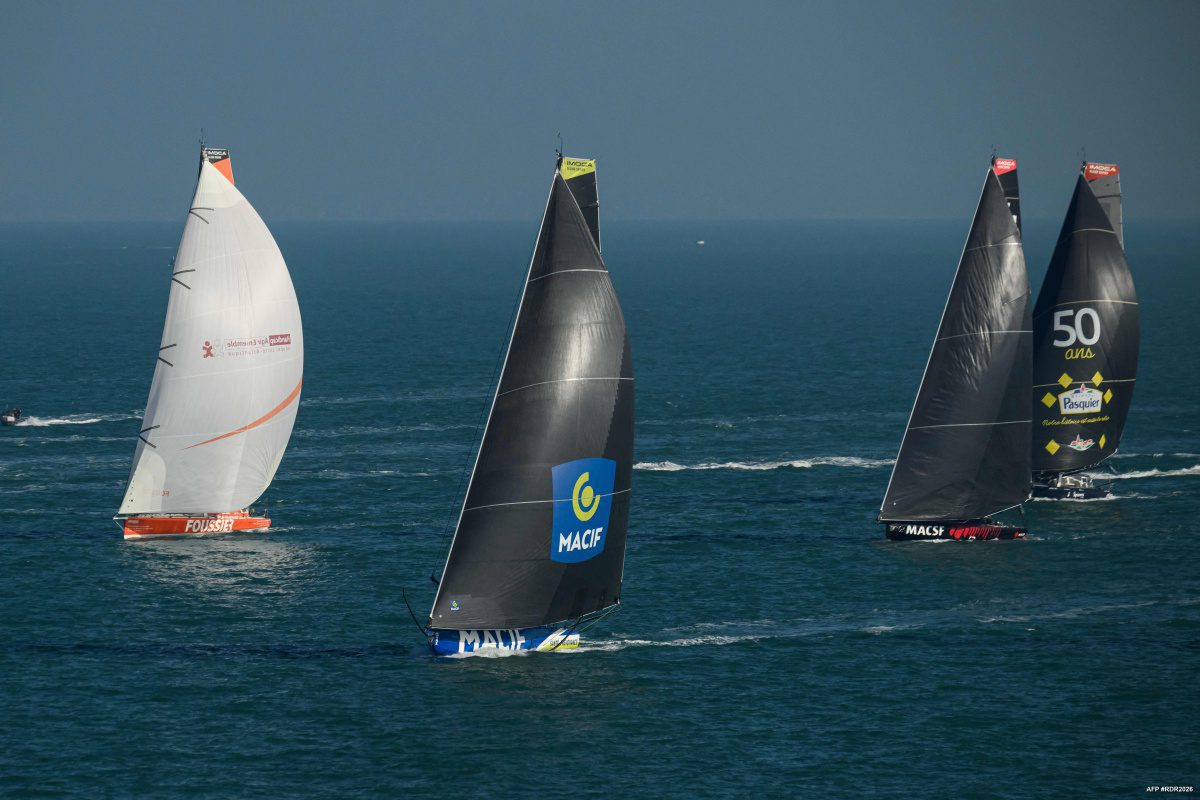
After setting off from Saint-Malo on Sunday, 1 November, in almost summery sunshine, the 115 skippers competing in the 13th Route du Rhum quickly faced the demands of offshore racing. Following a fast-paced first night, the favourites are already locked in an intense battle. Behind this pleasant opening, however, lies a particularly unsettled Atlantic, where strategic decisions are once again set to make all the difference.
At precisely 1:02 pm on Sunday, 1 November, the 115 competitors in the Route du Rhum – Destination Guadeloupe crossed the starting line beneath a brilliant blue sky, in a north-easterly breeze of 8 to 11 knots. These were unusual conditions for this autumn transatlantic race covering 3,542 miles between Saint-Malo and Pointe-à-Pitre, where the start is more often marked by challenging weather. From the very first minutes, the racing proved particularly close. The start was as spectacular as ever, with 115 boats vying to gain an advantage over their rivals. Everything went smoothly, although three competitors were penalised for an early start: Christophe Rateau, Marco Guerra and David Ducosson. The fleet then headed towards Cape Fréhel, the first course mark, located 16 miles from the start. The Ultims made repeated gybes, while the monohulls sailed under spinnaker to the delight of the spectators.
A demanding first night
Among the giants of the seas, the eagerly anticipated duel between Tom Laperche (SVR-Lazartigue) and Armel Le Cléac’h (Banque Populaire XI) immediately lived up to expectations. More efficient in his manoeuvres, Laperche took the lead after rounding Cape Fréhel. Close behind, Anthony Marchand (Actual Ultim 3), Thomas Coville (Sodebo Ultim 3) and Louis Burton (Armand Thierry) remain firmly in contention. Charles Caudrelier, aboard the new Gitana 18, demonstrated impressive speed potential, but also struggled to regain his rhythm quickly after manoeuvres.
Conditions changed dramatically overnight. The wind strengthened, the sea built up and boat speeds increased. The Ultims are now sailing in an east-south-easterly breeze of 15 to 18 knots, with peak speeds of around 35 knots. “We had a pretty tough night,” says Tom Laperche, fully aware that there is no room to ease off. In the Ocean Fifty class, Matthieu Perraut (Elvest) describes a demanding passage: “The sea is short and the wind has really picked up. We’ve been posting some big averages. It’s full-on, and we can’t see a thing outside!”
In the IMOCA class, Sam Goodchild (MACIF Santé Prévoyance) and Ambrogio Beccaria (Allagrande Mapei) are among the leaders. In Class40, Pierre Leboucher (Institut Imagine) has stood out despite sharp changes in wind strength, which locally shifted from 28 to 16 knots near the Scilly Isles. It has been challenging sailing for the entire fleet. The first night was also marked by a collision between Violette Dorange (Initiatives-Cœur) and Romain Pilliard (Use It Again). Both skippers were unharmed and made for Roscoff to repair their damaged boats.
A northerly route and weather traps
The real challenge now lies to the south-west of Ireland. On Monday, shortly before 4 am, Tom Laperche was the first to gybe, approximately 155 miles from the Fastnet Rock. It was a decisive move as the fleet approaches a narrow low-pressure corridor between two areas of high pressure. Forecasts point to rain, a temporary collapse in wind strength, followed by a return to a north-north-westerly flow. Further west, the lack of established trade winds is forcing the boats onto very northerly routes, north of the Azores. “We can’t see the exact pattern all the way to the finish,” Tom Laperche warned before the start. The next stages could therefore turn the rankings upside down. While the opening hours rewarded the fastest boats, the coming days are likely to favour the best tacticians.
More at: routedurhum.com