

Text and photos: Louis Taurel
In the heart of a scorching July, it is with undisguised pleasure that I head to the port of Thonon, where I’m meeting Philippe Séguret, owner and founder of Pro Yachting. The purpose of the meeting: to take advantage of the arrival of the brand-new Frauscher 797 Spectre to (re)discover the Haut-Lac and the Grand-Lac.
First contact
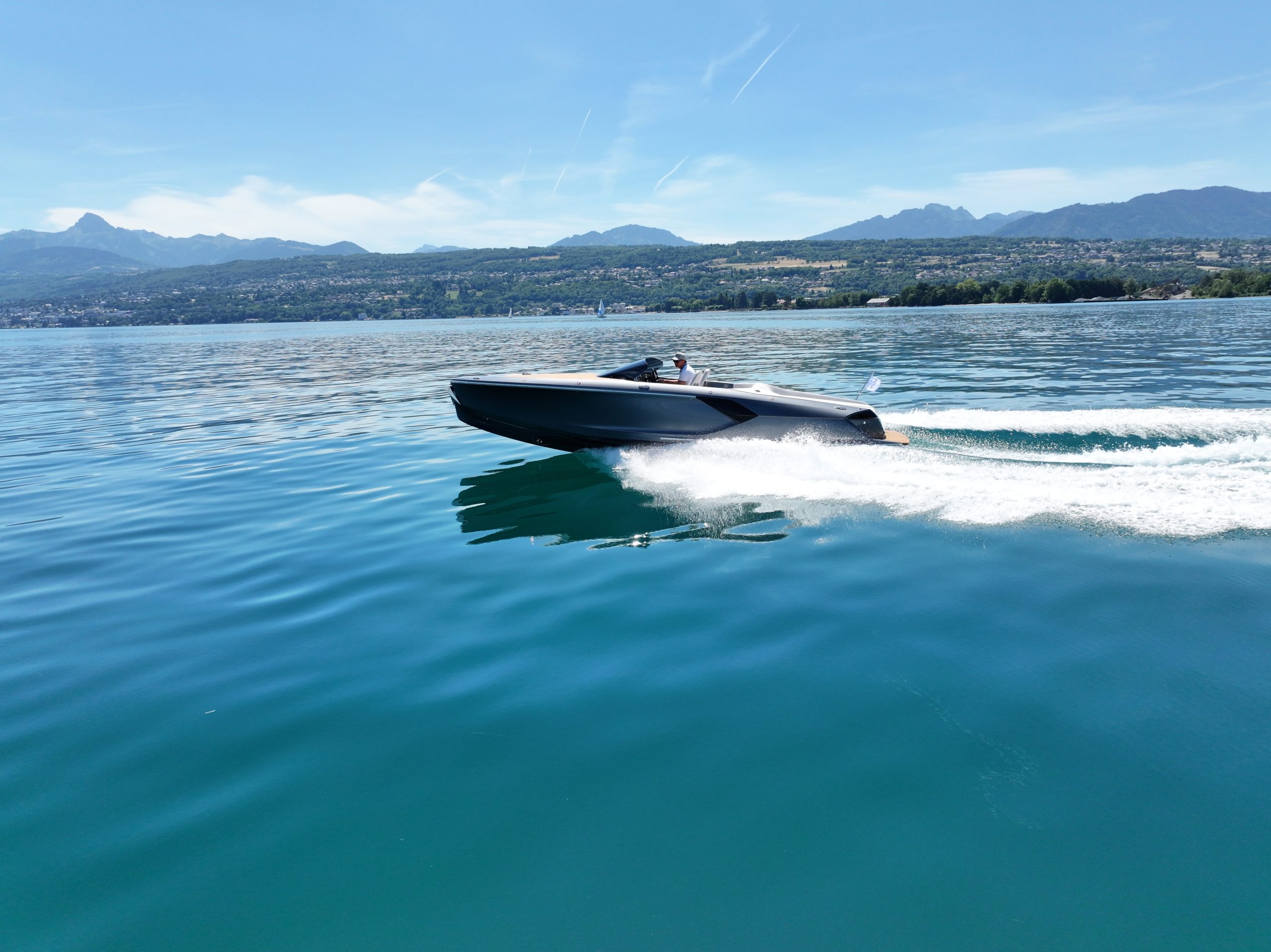
Set off by its metallic grey livery, white upholstery, speedster-style windscreen and immaculate teak deck, hull number two of the Austrian yard’s latest creation floats ready to slice across the glassy lake before us. At 7.92 m long with a 2.37 m beam, it looks both sleek and compact, and the proportions (as always in Frauscher’s runabout range) are perfectly balanced.
Although it is homologated for 7 people, it is clearly designed for 4. The driver’s semi-wraparound seat faces a bank of gauges. At the centre, as on a certain 911, sits the rev counter, graduated up to 7,000 rpm. The reading is slightly optimistic, since the 6.2 L Mercruiser V8 delivers its 350 horsepower at 5,400 rpm, the speed at which this Spectre planes at over 45 knots.
The canals of Port Ripaille
Once we’ve stowed the fenders and mooring lines in the lockers and put the camera gear away in the tiny cabin, we clear the 300-metre zone and can head for Port Ripaille. Seated low, the wraparound windscreen does its job fully: driver and passenger are completely sheltered from the wind. In temperatures like those on the day of our test, it makes sense to sit in the high position to catch as much air as possible. We enter Port Ripaille by the east entrance. Built in the early 1970s on part of the grounds of the Château de Ripaille, and modelled on Port Grimaud, this marina brings together 550 houses and apartments opening directly onto canals. Each dwelling comes with a mooring berth. Like its Var-based big sister, the boats are not limited to small craft: the maximum draught reaches 5 metres. You can even find a few Psaros 33s, including that of our pilot for the day. The atmosphere is discreet and nature omnipresent, with more than 800 plant species and some 200 bird species: Port Ripaille is built right in the middle of the Dranse delta nature reserve.
Leaving by the west, the swimmers on the breakwater can’t help noticing the Frauscher, giving us a few thumbs up.
Less is more
We decide to anchor so we can try out the bimini. It goes up quite easily: the engine hatch, topped with the sunpads, is raised electrically. The hood bows, nestled in the forward part of the compartment, then simply fold up and attach to the mooring cleats on either side of the windscreen: simple, effective and durable!
The same goes for the anchor: the anchor itself, streamlined and following the lines of the bow, is an integral part of the boat’s profile and therefore remains visible while underway. The retractable bow roller extends just slightly to move the anchor away from the hull and avoid the annoyance of scratching the superb metallic paint.
Lavaux bathed in sunshine
Heading for Cully! The lake is deserted, so much so that a veritable raft of cormorants has taken up quarters in the middle of the lake, as if to mark the border between the Haut-Lac and the Grand-Lac. Once we’ve passed these winged fishermen, we push the throttle to the maximum: in the day’s conditions, with no wind and no chop, we easily reach 45 knots. At this speed, our true 2+2 grand tourer proves stable and comfortable, even though the two front seats are not suspended. If you want to turn at high speed, the Frauscher remains stable and tracks precisely where you ask it to go, heeling elegantly. It doesn’t lose grip, and the thrust stays very lively even in the tightest turns. It’s worth noting that even when we crossed the wakes of other boaters or those of the CGN boats, at no point did the teak deck or the passengers get wet. The hull deflectors do their job wonderfully. We slow down to 23 knots to find the ideal cruising speed at 3,000 rpm. At this pace, the V8 consumes about 36 litres per hour, giving a range of more than 150 nautical miles.
Forming a natural harbour at the foot of the Lavaux vineyards, Cully devoted itself for several centuries to winegrowing and to exporting wine by lake, which gave it a certain economic footing. That prosperity ended in 1891 with the arrival of the Simplon railway, which put a stop to the transport of goods by lake. Over the years, various road developments have left this little lakeside town somewhat sidelined, allowing it to keep much of its authenticity. Its hinterland, railway line aside, is enhanced by terraced vineyards that offer, without doubt, one of the best vantage points for summer sunsets.
A UNESCO World Heritage site, the Lavaux vineyard is a unique cultural landscape born of Alpine geology and the Rhône glacier. Shaped by humans since Roman times and structured in the 12th century by Cistercian monks, this territory defies slopes as steep as 43°. To cultivate this difficult land, generations of winegrowers built stone walls to hold back the soil. This exceptional vineyard benefits from the famous “three suns”: direct sunlight, reflection off Lake Geneva, and the heat released at night by the walls.
Maker of neoclassical runabouts
Recognisable at a glance, Frauscher boats are the product of an almost century-old history. The yard’s origins go back to 1927. Initially, before the war, the young Austrian yard focused mainly on sailing craft. The brand gradually specialised in motorboats until it became the pinnacle of the runabout. Having extended the yard by nearly 800 m² in recent years, Frauscher produces about 80 units a year.
Operating outside fashion with a timeless, even neoclassical design, each new Frauscher does not make the previous model obsolete, once again like Porsche and its 911. Frauscher in fact maintains close ties with the Stuttgart giant, with which it has collaborated since 2021 on electric runabouts, which use the powertrain of the electric Porsche Macan.
We leave Lavaux, following the coast to Montreux. In the early afternoon we hear the Jazz Festival rehearsals there, then return to Thonon-les-Bains, 19 nautical miles to the west. The 797 Spectre is truly worthy of the badge it wears: elegant, fast, precise, easy to live with and well thought out. More than a runabout, it is to boating what personal luxury cars were to the United States in the 1950s. Centred on the comfort of driver and passenger, it puts style first, with clean, low lines giving a fluid, sporty silhouette. The power is there, available, but it must remain discreet and quiet so as not to disturb the comfort of use.
A few notes on the source text: “Lavaud” (in “Nous quittons Lavaud”) looks like a typo for Lavaux, and I translated it as such. “Pour nous atteindre” has a stray “nous”, which I read as “to reach 23 knots.” Also, “Haut-Lac” and “Grand-Lac” are the usual local names for the eastern and central parts of Lake Geneva, so I kept them in French. Add a short gloss if your readers may not know them.


