

Text ) Louis Taurel
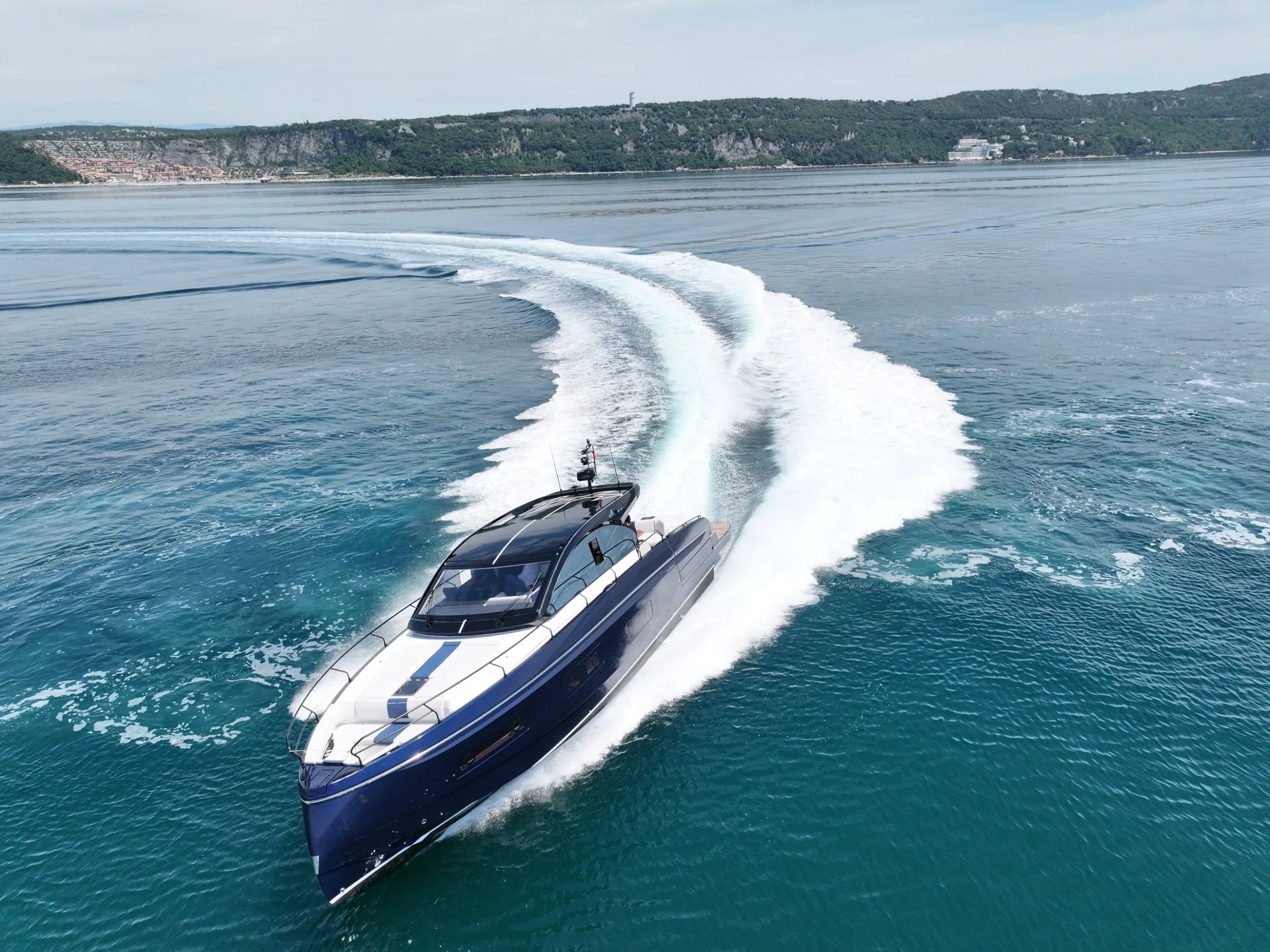
The Gran Turismo 50 offered to us for this test comes in a beautiful abyss-blue finish, characteristic of the limited-edition Alpine series. The painted hull is available as an option in addition to the Alpine package. The various generations of the Gran Turismo have always displayed their automotive heritage, but this new 50-footer makes that positioning particularly clear. Its taut lines, lower hull chine compared with its predecessors, reverse bow and beautifully finished upholstery all reinforce this impression.
There is also a clear step up in terms of the deck hardware: the rails, cleats and handrails are finished in matt black. The stanchions, also in matt black, are angled forward, creating a sense of speed even when the boat is stationary and secured to the dock. Another subtle detail is the discreet integration of LED lighting inside and outside the boat, further enhancing the Gran Turismo’s distinctive visual identity.
Moving into the aft cockpit, we find a central island incorporating sunpads, together with a large cockpit table capable of accommodating more guests than there are berths on board this Gran Turismo. Beneath the sunpad is a large storage compartment, ideal for carrying all the essential water toys for time spent at anchor.
The space available around this island may initially appear somewhat limited, but that is before taking into account the fold-out side sections on either side of the cockpit, as well as the wide aft bathing platform, which together provide approximately 12 additional square metres of usable space. The bathing platform has a load capacity of 400 kg and is 4.2 metres wide, making it more than large enough to accommodate a generously sized tender. On the port side of the platform there is a retractable bathing ladder. On the starboard side, a genuine staircase with folding steps emerges when the platform is lowered into the water.
Walking forward along the side decks, we find the usual sunpads as well as a forward cockpit recessed into the deck. This creates a small, sheltered cocoon while also providing a clever space from which to operate the retractable bow fitting without having to contort yourself.
Below deck, there are three cabins and two bathrooms: one dedicated to the owners, while the other serves as a day head and is shared by the two guest cabins. The quality of the finishes is equally impressive here. The black door handles are magnetic, allowing the doors to remain securely closed while underway.
Back on deck, the cockpit is separated from the saloon by a galley topped by a folding glass panel. This allows the interior and exterior spaces to be connected, while also creating a bar incorporating the sink and cooking hobs. In keeping with the Alpine finish, all these elements are finished in black.
At the helm, you are immersed in the automotive world: a tulip-style Alcantara steering wheel bearing the Alpine logo and a centre marker, a semi-bucket leather seat with contrast stitching, a carbon-fibre dashboard, and push buttons and controls that fall naturally to hand on the right. Beneath the helm is the numbered Beneteau X Alpine plaque. This is a limited edition of just 110 boats, a reference and tribute to the legendary Berlinette that established Alpine’s reputation on the road, in rallying and on the circuit from 1962 to 1977.
It is time to start the engines: two 480 hp Volvo engines with IPS drives. The sound insulation is still not perfect, but it has improved considerably compared with previous versions. Once the access channel to Monfalcone is behind us, it is time to see whether this boat is as dynamic on the water as its appearance suggests. Conditions on this mid-June day are ideal: very little wind, calm seas and a brand-new, perfectly clean hull.
At the helm, the Gran Turismo feels remarkably responsive and precise. It is difficult to believe that we are aboard a 50-footer weighing more than 18 tonnes with seven people on board. The boat easily reaches its top speed of 31 knots. At this pace, it feels as though it is riding on a cushion of air, remaining perfectly level. With the automatic trim left engaged, it turns flat without cavitating, retaining all of its traction even during tight, high-speed manoeuvres.
The target fast cruising speed is 26 knots. At this speed, fuel consumption is 155 litres per hour, giving a range of 201 nautical miles with a 10% reserve taken into account. At 17 knots, the boat is also comfortably on its lines, while fuel consumption drops to below 100 litres per hour.


Photos ) Louis Taurel