


The new power flagship takes things to an even higher level
Words) Emmanuel van Deth
Unveiled as a world premiere at the Lagoon Exclusive Days in Bordeaux, the Eighty 3 replaces the Seventy 8 with a clear ambition: to take Lagoon’s flagship powercat into a new dimension of ultimate luxury. While the hulls retain some elements of the previous generation, everything else is new. Increased volume, far greater scope for customisation, carefully designed crew quarters and an unmistakable influence from large motoryachts mark an important step in the builder’s move upmarket.
A new chapter in the world of multiyachts
At Lagoon, replacing a flagship means much more than a cosmetic update. The Seventy 8 played a major role in establishing the French builder in the exclusive market for large luxury powercats, where Sunreef Yachts and Fountaine Pajot are currently among the leading players. With the Eighty 3, the aim is no longer simply to renew an existing model; Lagoon wants to offer a more sophisticated and luxurious multiyacht.
The brief given to naval architects VPLP and Lagoon’s engineering team was straightforward: provide more volume, further improve movement around the boat, offer a level of customisation rarely seen on a production multiyacht, and bring the experience closer to that of today’s large motoryachts.
“We wanted to go much further with customisation while preserving Lagoon’s DNA,” explains Fred Signat, Lagoon Service Premium Manager, who accompanies us throughout our tour of the Lagoon Eighty 3. “As long as the structure itself does not have to be altered, we can now meet practically any request from an owner.” This philosophy runs throughout the project. The Eighty 3 remains a production model, but it moves decisively towards the semi-custom segment.
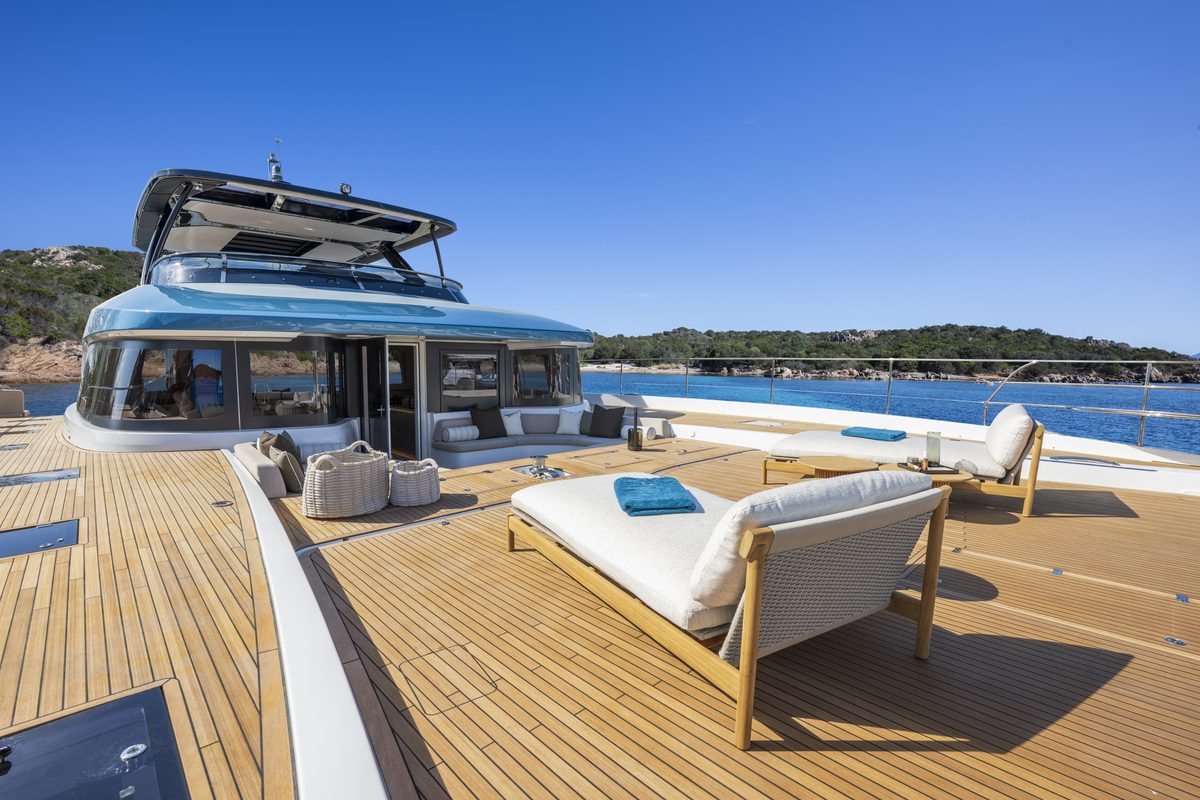
Our test boat, the first hull built, immediately demonstrates this desire to stand apart. The deckhouse features an elegant turquoise metallic finish, while the hardtop is finished in particularly striking black. The combination evokes the styling of large Italian yachts more than the traditional design language of cruising catamarans.
Movement around the boat comes first
The sense of space is apparent as soon as you step aboard. The side decks are particularly impressive, offering far more width than those of the sailing version, the Lagoon Eighty 2, whose deck is necessarily dominated by a substantial standing rig. On a multiyacht measuring nearly 25 metres, this makes a considerable difference to the way people move around. Even when several people pass one another, there is no sense of being constrained. The impression is reinforced by higher bulwarks than before, complemented by a sturdy stainless-steel guardrail that keeps the crew secure in a wide range of sea conditions.
This emphasis on easy movement extends across all the exterior decks. Routes around the boat have been designed to minimise changes in level and avoid obstacles wherever possible. The result is particularly convincing on a yacht intended to accommodate large numbers of guests.
Forward, the cockpit can be configured in several ways to suit the owner’s plans. It can accommodate generous sunpads, a lounge area or a dining space protected by removable parasols. The forward ends of the hulls can also be configured to suit individual requirements. A workshop, laundry room, additional storage, crew cabin or technical spaces are all possible, allowing each owner to adapt these areas to their intended use.
Aft, the cockpit retains one of the defining features of larger Lagoons: a huge hydraulic platform capable of carrying up to 1.3 tonnes. When lowered, it provides almost 22 m² of additional space at water level, making swimming easier and providing convenient access for launching a particularly large tender or several water toys. For long-distance cruising, it is hard to imagine a more versatile feature.
An interior inspired by large motoryachts
The real surprise, however, awaits inside.
The Eighty 3 breaks quite decisively with the design language of previous Lagoon models. The builder entrusted the transformation to Italian studio Nota Design, already well known in the motor-yacht world. The objective was clear: create a more residential atmosphere without resorting to ostentatious displays of luxury.
The result is undeniably successful. Large slabs of dark marble are paired with glass panels, leather finishes sit alongside carefully selected wood veneers, and freestanding furniture creates the impression of being in a luxurious contemporary villa rather than on a boat. The overall effect is certainly more sophisticated than that of the Seventy 8, yet it retains a degree of restraint that avoids decorative excess.
The main living area naturally benefits from spectacular proportions. Huge vertical windows open up broad views of the sea, while the different spaces flow seamlessly into one another. The lounge, dining area and galley can be arranged in several configurations, depending on the chosen cabin layout and the owner’s lifestyle.
This flexibility is one of the Eighty 3’s major innovations. The galley can be positioned aft, in the centre of the main living area or even in one of the hulls, depending on the owner’s wishes. Such freedom of design remains unusual on a production multiyacht. Once again, Lagoon is openly moving closer to the world of fully customised yachts.
An owner’s suite that remains spectacular
One feature that Lagoon regulars will immediately recognise is the spectacular owner’s suite in the starboard hull. The Eighty 3 retains one of the Seventy 8’s signature features: the well-known opening side bulwark, which transforms the cabin into a private terrace just above the water when opened.
Just three steps separate the sleeping area from this exclusive platform, where it is easy to imagine enjoying a morning coffee or reading at the end of the day, with the water gently lapping nearby. More than a styling flourish, this opening creates a special connection with the sea and remains one of the defining features of larger Lagoon yachts.
The suite offers impressive space. The centrally positioned bed faces the side windows to make the most of the view, while a large dressing area occupies the central section of the hull. The generously proportioned bathroom also makes extensive use of the marble, glass and wood finishes found in the main living area. The overall impression is closer to a hotel suite than a cabin aboard a multihull.
Depending on the owner’s requirements, the Eighty 3 can be fitted with four to six cabins. This flexibility makes it suitable both for family cruising and for high-end charter operations, two markets in which Lagoon remains particularly active.
The crew has not been overlooked
The same flexibility extends to the crew quarters, which are among the best-designed we have seen on a production multihull.
This may seem like a secondary consideration to some readers. Yet it becomes essential on yachts exceeding 24 metres. Crew comfort has a direct impact on morale and commitment – something no owner can afford to ignore, and something Lagoon has clearly understood.
The two dedicated crew cabins feature proper berths, plenty of storage and a separate bathroom. Most importantly, they are complemented by a crew mess with a service galley, allowing the crew to go about their daily lives without encroaching on the guests’ private spaces. Such a well-developed arrangement is far from standard on a multihull in this category.
Movement around the yacht has also been carefully considered. A large hatch provides direct access to the deck, while a separate circulation route allows the crew to reach the technical areas without passing through the guest reception spaces. This discretion quickly becomes a luxury when several guests are living aboard for weeks at a time.
The thinking goes well beyond simple comfort. It reflects a shift in the intended use of the Eighty 3. Lagoon is no longer addressing only owners who cruise with their families, but also those planning intensive use with a permanent crew – an increasingly common arrangement on multiyachts of this size.
A flybridge designed as a proper upper deck
Rather than cramming the flybridge with equipment, the designers have prioritised a large panoramic terrace where movement remains as easy as on the main deck. The helm station is naturally positioned forward, offering excellent visibility over the water. Optional remote controls make manoeuvring in the tightest marinas even easier.
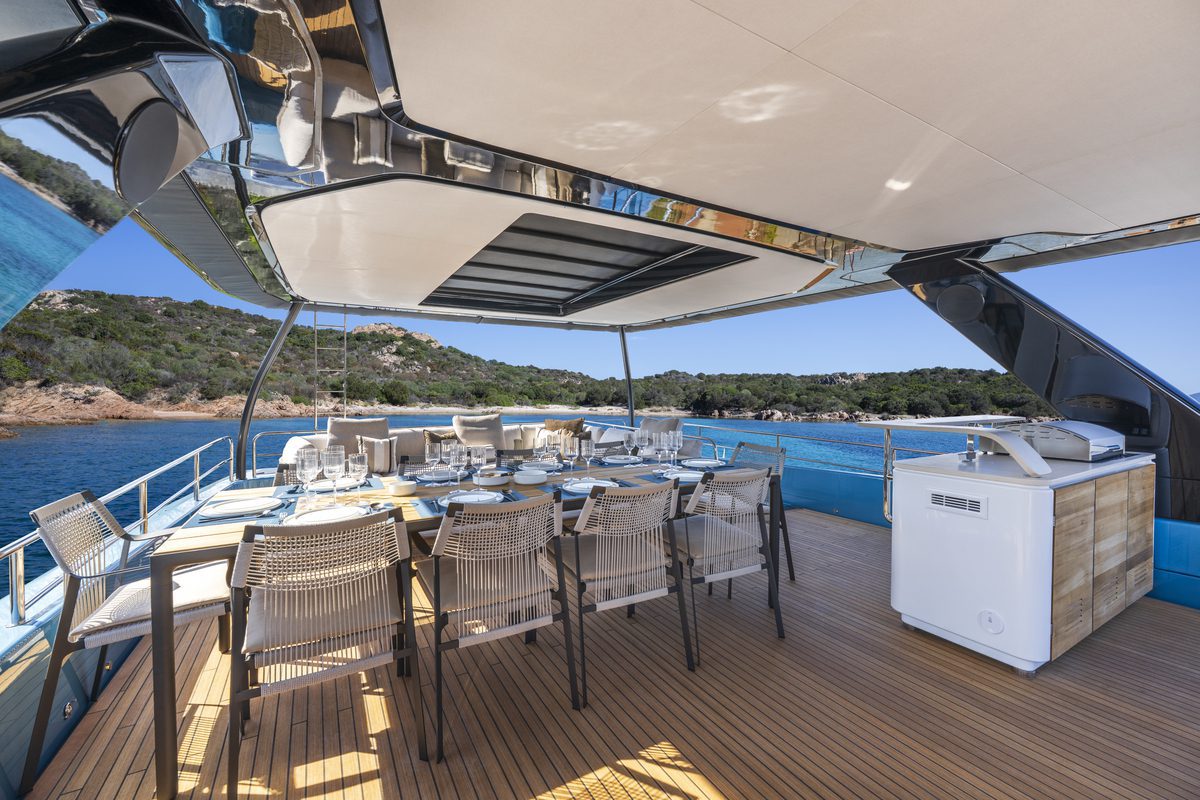
Behind the helm is a huge entertaining area arranged around a large table, a bar unit and several cooking modules. The outdoor furniture supplied by Tribù underlines Lagoon’s intention to work with partners from the high-end furniture world rather than relying solely on traditional marine suppliers.
The aft section features expansive sunpads with completely unobstructed views. Here again, owners can tailor the equipment extensively to suit their plans, with options such as a barbecue, wine cooler, ice maker, additional refrigerators or bespoke furniture.
Ultimately, the flybridge functions almost as a second outdoor lounge, comfortably accommodating a dozen guests.
A production multiyacht that is almost custom-built
Lagoon does not claim to offer a fully custom yacht. The platform, structure and main layout remain those of a production model, as one would expect. However, materials, finishes, equipment and a large proportion of the interior arrangements can now be tailored to the owner’s preferences.
The builder has even established a dedicated team to handle this work (see box).
With more than 7,000 catamarans built, the yard now has a loyal customer base that wants the reliability of industrial production while benefiting from a level of customisation previously reserved for much more exclusive, bespoke yachts.
The Eighty 3 perfectly illustrates this evolution: retaining Lagoon’s industrial production capabilities while offering a level of personalisation that brings the builder closer to the semi-custom world.


photos) Gazeau Julien